Free Non-Credit Course in Customer Service, Radical Hospitality & Trauma Informed Ministry for frontline workers.

Request Information

Free Course in Customer Service, Radical Hospitality & Trauma Informed Ministry

This free non-credit course by City Vision University is designed to equip frontline workers to compassionately and effectively serve marginalized individuals from high-trauma backgrounds, such as those experiencing homelessness, addiction, or incarceration. The curriculum uniquely integrates three complementary disciplines: the structural efficiency and needs identification of corporate customer service, the psychological safety and de-escalation techniques of clinical trauma-informed care, and the deeply rooted Christian theology of radical hospitality that recognizes the inherent dignity (Imago Dei) in every person.

Through its modules, the course teaches that true life transformation relies on relational service rather than transactional charity, focusing on practical skills like the “ministry of the first encounter,” empathetic listening, and behavioral adaptability when dealing with difficult or escalated clients. Finally, the course addresses the intense emotional toll of this work, providing practical and spiritual strategies to manage emotional labor, prevent burnout, and discern a sustainable, long-term calling in high-trauma ministries.

The intention is that this could serve as an outline for an eight session training course for staff at your ministry as follows:

  1. Staff would read through the assigned readings in Miss Brenda and the Loveladies and optionally in Radical Hospitality Benedict’s Way of Love before each session. 
  2. You could watch the assigned videos at the beginning of the session
  3. You could then have a discussion about how the materials apply in your context starting with the discussion questions provided, but feel free to add your own.

  • Discussion Questions
    • Reflect on the article Theological Basis for the Ministry of Radical Hospitality. Why is this so important? 
    • This course integrates the fields of 1) radical hospitality (theology), 2) customer service (business) and 3) trauma-informed care (clinical counseling). Explain why providing effective customer service and radical hospitality is particularly helpful in establishing safety/trust for those coming from high trauma backgrounds.

    • Read specifically on Shay’s and Tiffany’s inner dialog sections that are a part of the “Practical Examples of Radical Hospitality from the Lovelady Center” in the article The Ministry of the First Encounter: Radical Hospitality as Pretreatment for the Marginalized. Reflect on how we often may not know what is going on in clients/guests’ heads (internal dialog) when we first greet them.
    • Based on that same story, explain why providing radical hospitality as a part of the Ministry of the First Encounter can be transformative. 
    • If you have had any experiences of similar radical hospitality (especially in a Christian context) either yourself or that you’ve observed with clients/guests, share those. Be sure to respect client confidentiality.
    • Often “customer service” and greeting clients/guests can feel like mundane work. After reflecting on “The Ministry of the First Encounter” and your own observations, summarize in your own words why this “Ministry of the First Encounter” is critical in enabling transformation.

  • Discussion Questions
    • While many front-line workers in Christian ministries may not be trained in clinical counseling techniques, they often practice what are called “common factors” in counseling terminology. Explain why many of the principles of good customer service and radical hospitality of frontline workers are similar to common factors in counseling?
    • Reflect on the “Examples of Relational Service & Common Factors from The Lovelady Center” section of the article Relational Service: the Heart of Radical Hospitality that Brings Life TransformationLinks to an external site. and other aspects of the article. Based on that, explain why the model used by many ministries is often more effective than secular providers.
    • This week’s article Relational Service: the Heart of Radical Hospitality that Brings Life TransformationLinks to an external site. and last week’s article The Ministry of the First Encounter: Radical Hospitality as Pretreatment for the MarginalizedLinks to an external site. intentionally integrate the language and frameworks of 1) clinical counseling with those of 2) customer service and 3) radical Christian hospitality. Why is it helpful to have all three perspectives? 
    • Considering your response to the previous question, explain why in establishing the trust needed for life transformation with clients/guests, all touchpoints and experiences in the ministry are important (i.e. frontline workers, case managers, counselors, chaplains, etc.)

    • Describe experiences where others listening to you well have been transformative?
    • Similarly describe experiences where you have observed someone else’s transformation through effective listening (by yourself or someone else, be sure to protect client confidentiality)?
    • Revisit and reflect on the common barriers to effective listening described in the article. What are the barriers that you most often encounter when attempting to listen effectively? What can you do to address those?
    • Revisit and reflect on the suggestions for effective listening from the article. What of those suggestions should you attempt to implement? Describe how you might do that.

    • RIDE Model. Reflect on the RIDE Model of different personality styles (Rational (R), Inquisitive (I), Decisive (D) & Expressive (E) of customers/clients/guests. What are the styles that you have the most difficulty with? What is the recommended response to that style? How is that different from your default response?
    • Changing Your Behavior. Often the style of our response (behavior) reflects more of our own personality and preferences rather than what the customers/clients/guests need to foster their growth. What specific steps can you take to adapt more to their needs rather than your own preferences? What makes this type of adaptation difficult?
    • Handling Relapse and Radical Grace. When Stephanie stole money and disappeared, Brenda struggled but eventually forgave her, leading to Stephanie’s return and restoration. Discuss the tension between “enabling” bad behavior and offering “radical grace.” Why was Brenda’s forgiveness more effective than prosecution might have been? What boundaries would you need to practice this safely?
    • Common Factors in Action: Research suggests that who you are (Genuineness, Empathy) matters more than what technique you use. Do you agree? Can you think of a time when a “technically perfect” intervention failed because the relationship was cold? Conversely, can you think of a “clumsy” intervention that succeeded because the love was genuine?

  • Reading
  • Discussion Questions
    • The “False Self” as Armor: In Miss Brenda and the Loveladies, Shay presents a terrifying “False Self” (aggression, cursing) to protect herself upon arrival. Identify a client or person in your ministry who presents a “prickly” exterior. What specific “True Self” qualities (e.g., leadership, sensitivity, loyalty) might be hiding behind that defense? How can you verbally affirm those hidden qualities?
    • Usefulness of False Self Framing. Often when confronted with the aggressive side of a client, it can be difficult to avoid becoming entangled and dysregulated from their intensity. Explain how the framework of perceiving that side of them as a “false self” can be helpful to enable you to disentangle yourself from that intensity? Feel free to provide examples (protecting client confidentiality).
    • De-escalation Techniques: Reflect on the de-escalation techniques recommended in the article. Share any experience you have with deescalating with someone else (protecting client confidentiality). What techniques do you use that you find most helpful? What techniques do you think you could try to exercise more effectively?
    • The Theology of “No Exclusions”: A Christian understanding of ministry is that we must serve everyone, just as Jesus touched the leper. However, clinical wisdom emphasizes safety. How do you balance the spiritual mandate of “No Exclusions” with the clinical necessity of “Safety” when dealing with a client who is physically violent or threatening? Where is the line between “radical hospitality” and “enabling abuse”? Feel free to provide examples (protecting client confidentiality).
    • Rupture and Repair: The “Ice Cream Standoff” shows a leader (Brenda) failing to regulate her emotions. Have you ever “lost your cool” with a client? How did it affect the relationship? Using the concept of the “Therapeutic Alliance,” how could you have gone back and “repaired” that rupture to actually strengthen the bond? Feel free to provide examples (protecting client confidentiality).

  • Discussion Questions
    • Frontline Ministry & Customer Service. Explain why there are often similarities between the stress and emotional labor in frontline ministry and customer service jobs, especially in terms of dealing with angry customers and clients. Provide your own experience if applicable. 
    • Surface vs. Deep Acting in Your Ministry. Reflect on your recent interactions with difficult customers or clients. Can you identify a moment where you used “Surface Acting” (faking a smile/concern while feeling angry or checked out)? How did you feel afterward (exhausted, cynical)? Can you identify a moment of “Deep Acting” where you actively reframed your perspective (e.g., “This is a wounded child of God,” or “This aggression is their armor”) to change your internal emotion? How was that experience different? Application: What is one specific “cognitive reframe” or prayer you can use this week to move from Surface to Deep Acting when triggered?
    • The Inner Cloister and Sabbath. The article suggests that frontline workers need an “Inner Cloister” or a “Cell” for withdrawal. Do you currently have a “cloistered space” (physical or temporal) where you are completely off-duty and alone with God? What are the barriers (internal guilt, external demand, “Messiah Complex”) that prevent you from practicing a true 24-hour Sabbath?  Are you willing to set a one 30-minute block this week to practice “doing nothing” but being with God. If you have already done this, report back on how it felt.
    • Wounded Healers and Boundaries. For those with lived experience related to any elements of what customers clients experience (trauma, addiction, etc.). Have you ever experienced “Emotional Fusion”—where a client’s relapse or failure ruined your day or week? How does the concept of “Differentiation of Self” (I am me, you are you; I am responsible to you, but not for you) help in that scenario? Discuss the specific risks of “Retraumatization” in your current work environment. What is one “Universal Precaution” you can put in place to protect yourself?
    • The Cost of Listening. Henri Nouwen speaks of the “Cost of Listening.” How do you currently “metabolize” the trauma stories you hear? Do you carry them home? Who listens to you? (Supervisor, spouse, therapist, peer group?) If you realized today that you were suffering from Vicarious Trauma (worldview shift, cynicism, fear), what would be your first step toward recovery?
    • Radical Hospitality vs. Enabling. How do you balance the “No Exclusions” principle of Radical Hospitality with your own needs for safety and boundaries? Discuss a time when you had to set a hard boundary to protect your own well-being. Did it feel like a failure of hospitality, or an act of self-stewardship? How does this paper reframe that experience? What potential steps do you need to take related to this?

  • Discussion Questions
    • The “Sell Out” Myth: Have you ever felt guilty for wanting a higher salary or a role away from direct client care? How does the “Theology of Stewardship” discussed in this paper challenge that guilt?
    • Evaluating Emotional Labor: Reflect on your current role. On a scale of 1-10, how much “Surface Acting” (faking emotions) do you do daily? Would moving to an Administrative (Path 3) or Management (Path 2) role likely increase or decrease this specific burden for you?
    • The Wounded Healer’s Risk: If you identify as a Wounded Healer, have you experienced “Shared Traumatic Reality” where a client’s struggle triggered your own? How might a transition to a Licensed Counselor (Path 2) or Ops Manager (Path 3) provide better boundaries for your own recovery?
    • Career Mapping: Look at the salary tables in Parts 2, 3, and 4. Which financial reality aligns best with your family’s long-term needs (housing, retirement, kids)? Is your current educational path at City Vision aligning you with that reality?
    • Administration as Ministry: Read 1 Corinthians 12:28. Paul lists “administration” (or “guidance/governing”) as a spiritual gift alongside miracles and healing. Why do we often rank it lower in the church? How would your view of a desk job change if you saw it as a Charisma (spiritual gift)?
    • Your Path and Goals. Of the career paths listed in this article (or others), which are you considering (list in order of preference) and why? What are your specific goals and concrete actions to help you get there?

WHY CHOOSE CITY VISION?

Founded by Nonprofits for Nonprofits

Flexible Admissions & Transfer Credit Process

Accreditation

We are accredited by the Distance Education Accrediting Commission, which is listed by the U.S. Department of Education as a recognized accrediting agency.

We are an Approved Provider for NAADAC, which allows us to provide an educational path to addiction counseling certification in most states.

Flexible Online Courses

With our 8-week format and 5 start dates per year, you can study on your schedule in 100% online courses. You never have to travel to a physical campus.

Our online courses are like live courses but instead of live lectures, most are recorded. Instead of live discussion, you have discussion forums with other students.
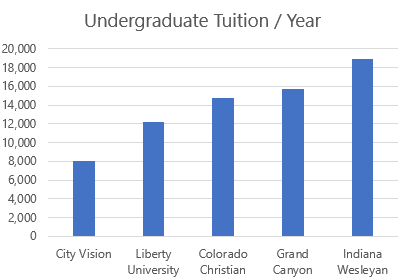
Radically Affordable so You Can Graduate Without Federal Loans

2023 City Vision Undergrad Tuition Comparison Chart

Which City Vision Degree is Right for You?

$ 800
 Per
 Course
  • 60 credits, 2 years
  • $8,000 per year (full-time)
  • 7 required core courses
  • Up to 45 transfer credits
  • Pell Grant Eligible
$ 800
 Per
 Course
  • 120 credits, 4 years
  • $8,000 per year (full-time)
  • 10-12 required core courses
  • Up to 90 transfer credits
  • Pell Grant Eligible
Popular
$ 800
 Per
 Course
  • MBA & MSADC: 36 credits, 1.25 yr
  • MSNM & MACML: 30 credits, 1 year
  • $8,000 per year (full-time)
  • Up to 25% as transfer credit

Awards & Recognition

lesly juarez 431855 unsplash crop v2

You Work to Transform Lives - Let Us Be a Guide

Like us, you work to transform lives. But some people you serve may appear stuck in dysfunction. You may feel over your head, like no one trained you for this. The needs seem endless, and you want to be more effective.

You know you need training to serve well, but you don’t have the time to stop working to get trained. City Vision’s flexible online programs allow you to balance work, family, and the rest of your life.

You deserve an affordable, flexible degree so you can help move your nonprofit to profound success. We want our students to know they are making a difference.

You may feel like your current position is an accident. But there are no accidents in God’s plan. Study with City Vision, clarify your calling, and be equipped to transform more lives than you’ve imagined.

Frequently Asked Questions

To get credit for experience, first take City Vision’s Prior Learning Assessment Portfolio Development course, which uses the CAEL portfolio process. In this course you will develop a portfolio of your learning experience using a template we provide. For each subject area where you believe you should receive credit, you must identify a course at an accredited institution where you believe that you have already mastered the learning outcomes for that course. For each course that you want to receive credit for, you need to develop a specific portfolio section where you provide several pages of documentation on how you have achieved the learning outcomes of the course. A faculty member then reviews your portfolio to assess whether you have provided adequate documentation to be granted credit.

After completing this eight-week course, you will get 3 elective credits toward your degree plus the credits for any courses where you documented that you met the course outcomes through your portfolio. You have up to 3 months to submit the rest of your portfolio to get credit for additional courses where you can document learning. After the three months, you can pay $100 to have additional sections of your portfolio reviewed. Undergraduate students can receive credit for up to 25% of their degree through prior learning (30 credits for a bachelor’s or 15 credits for an associate’s) and graduate students can receive credit for up to 25% of their degree (9 credits for an MBA).

We have credit recognition partnerships with Wheeler Mission, The Urban Ministry Institute (TUMI), Third Millennium, Saylor Academy, Vision International, Harvestime Institute, Genesis Process and YWAM’s University of the Nations. If you are with an organization that would like to set up a Credit Recognition Partnership, please contact us.

For the 2025-26 year, we offer the following tuition scholarships:

Here are the steps to request a scholarship:

  1. New Students Only: Fill out a free enrollment application. If you have already applied to the school, don’t do this again.
  2. All Students: Email the financial aid office at financialaid@cityvision.edu to say which scholarship you are requesting. There is not a form for requesting scholarships.
  3. The financial aid office will contact you if we need documentation to verify you are eligible for a scholarship.
  4. Be sure to read our criteria to keep scholarships.

City Vision offers two types of partnerships with organizations.

Multi-Student Organizational Discounts. We offer a scholarship to students from any organization that refers multiple students to City Vision in a given year. The scholarship makes tuition $5,500 ($550/course) for both undergraduate and graduate programs. If an organization does not have more than one student for at least a year, that organization loses its scholarship status. If you are with an organization that would like to receive this discount, please contact us.

Credit Mapping Partnerships. City Vision sets up credit mapping articulation agreements with ministries that have high-quality ministry training that can be evaluated through our prior learning assessment process. We have credit mapping partnerships with Wheeler Mission, The Urban Ministry Institute (TUMI), Third Millennium, Saylor Academy and YWAM’s University of the Nations, among others, that work in conjunction with our prior learning process. If you are with an organization that would like to set up a Credit Mapping Partnership, please contact us.

Yes. City Vision has worked with many employers that offer tuition assistance or reimbursement.

For students whose employer will pay their full tuition, we can work with you to send your tuition invoice to your employer for them to pay directly.

For students that pay their own tuition and need reimbursement with their employer, we provide the invoices and documentation you need to get reimbursed.

City Vision believes we are among the best in the world in providing an extremely practical Christian education for those interested in Addiction Counseling and Nonprofit Management. 

While state schools can provide information about counseling, City Vision will provide very practical counseling education with deep Christian integration. Similarly many state schools’ nonprofit management programs are often essentially generic business degrees, while we help our students integrate their Christian values in how they run nonprofit organizations and businesses.

Many community colleges or state schools will advertise “free” or nearly free tuition. Historically, for City Vision students that have applied for a Pell grant, 79% have qualified. For students that receive a full Pell grant, the grant will pay all your tuition making the cost to the student only the cost of books (which is similar to many community colleges or state schools). 

City Vision is very focused on providing extremely practical Christian education for those interested in Addiction Counseling and Nonprofit Management. City Vision offers fewer degrees than the mega-universities, but the degrees that we do, we do very well. We like to think of ourselves similar to the family-run hardware store where staff can answer all your questions with personalized service as opposed to the big box department stores like Walmart that offer everything. 

Liberty and Grand Canyon are fine schools if they are what you are looking for, but we believe we are superior for students seeking an affordable, practical education in what we teach. The following shows how we believe our strengths compare to those of Liberty and Grand Canyon:


City Vision

Liberty/Grand Canyon

Cost/Tuition

$8,000 per year

$12,198/$15,725 per year

Core Competencies

Nonprofit Management & Addiction Counseling degrees, with personalized service and practical training

Hundreds of degrees, convenience that comes from scale of 100,000+ students

History/Culture

20+ year history of serving the poor, addicted and underserved, including partnerships with rescue missions and Salvation Army

Liberty was founded by Jerry Falwell. 

Grand Canyon was a for-profit school.

Speed to Degree

Extremely flexible acceptance of transfer credit and prior learning credit 

Somewhat flexible transfer credit.

Student Recruitment

Primarily word of mouth and partnerships with 90+ rescue missions, Salvation Army, counseling centers, 500+ nonprofits and urban ministries

$100 million+ advertising campaigns

We have never had a student who wasn’t accepted into a graduate program based on our degrees, although in some cases with state schools we have had to advocate for them.

Our alumni have been accepted into the following schools: Grand Canyon University, Bay Path University, Southwest Baptist Seminary, Fuller Seminary, California University of Pennsylvania, James Madison University, Liberty University, North Park University, Southern New Hampshire University, St Mary’s University of Twickenham, Trinity Bible College, Bakke Graduate School and AG Theological Seminary.

Ultimately the acceptance of any degree or transfer credit is up to the receiving institution.

City Vision is nationally accredited by the Distance Education Accrediting Commission (DEAC), which is recognized by the US Department of Education and CHEA. The US Department of Education does not recognize a distinction between regional and national accreditation in its standards and recently stated, “The Department does not believe…that rejecting transfer credits, an application for admission to graduate school, or a request to sit for a State occupational licensing exam on the basis of the type of Department recognized accreditation is justified.” See the US Department of Education letter on National vs. Regional Accreditation.

We have heard from a number of our students that other schools (sadly, even Christian schools) use scare tactics as a part of their sales practice, and misrepresent the significance of the distinction between national and regional accreditation.

From a Christian social justice perspective, many have called the distinction between regional and national accreditation a cartel that is a major injustice that hurts the poor.  Having said that, there are those that still maintain this distinction, so we address their concerns in this section. This letter from Dr. Leah Matthews addresses some concerns about the quality of DEAC accreditation.

Functionally, our experience has been that the distinction between regional and national accreditation is primarily of importance for:

  1. Student pursuing academic careers, since many high-end schools may require Ph.D.’s from regionally accredited schools. A very small percentage of jobs (mostly academic) require regional accreditation.  For example, a recent search of jobs in Boston showed 19 jobs out of 65,645 total requiring regional accreditation (of which 18 were in academic institutions).
  2. Students pursuing licensing in fields that often require a master’s degree from a regionally accredited school, such as Counseling or Social Work. It is because of this reason that City Vision does not offer master’s programs in these fields. As listed above, regional master’s programs to date have always accepted our bachelor’s degrees, but the decision is up to each individual school.
  3. Students planning to complete their bachelor’s degree at other schools. Many state schools and some CCCU schools may not accept transfer credits from nationally accredited schools. It is up to each school on what transfer credits they accept. Based on this, for students that come to City Vision that do not plan to complete either their associate’s or bachelor’s with us, but expect to complete at a state university or CCCU school, we recommend that they first check with that school on credit transferability.

Ultimately, choosing City Vision’s national accreditation over a regionally accredited school is a question of value: you get more for your money with City Vision. If you need the “gold plating” of regional accreditation for one of the reasons described above, then it may be worth paying 2-10 times more to get a degree with regional accreditation from another school. However, because of the career choices of our students, they prefer to choose the value of City Vision rather than more expensive high-end options.

Historically, 70-80% of our alumni work in the nonprofit or ministry sector after graduation. 

The others work in business with strong values that reflect strong social responsibility, Christian values and entrepreneurship. 
We have had hundreds of students that have come from over 90 Gospel rescue missions.
Vann Ellison

“The partnership with City Vision has been one of the most important factors to equip our team to minister to the needs of the poor. Without this partnership, we wouldn’t be nearly as effective serving our most vulnerable neighbors.”

– Rev. Vann Ellison, Former President, St. Matthew’s House

Request Information